

In today’s S.O.A.R article we will discuss v speeds and how important they are for safe flying.
V speeds are standardized reference speeds that ensure safe and efficient aircraft operation throughout every phase of flight. Derived from the French word vitesse (“speed”), each value represents a certified aerodynamic, structural, or performance threshold specific to an aircraft’s weight, configuration, and environmental conditions. By defining safety margins and clear operational decision points, particularly during takeoff, climb, and landing. V speeds form a fundamental component of disciplined flight operations for pilots, engineers, and aviation professionals.
Why V Speeds Matter
V speeds provide:
- Defined safety margins across all phases of flight
- Clear go/no-go decision points in abnormal or emergency situations
- Performance optimization for efficiency, obstacle clearance, and structural protection
Without standardized reference speeds, flight operations would rely heavily on estimation, significantly increasing operational risk.
Takeoff Reference Speeds
V1 — Decision Speed
The maximum speed at which a rejected takeoff can be safely executed within the remaining runway. Beyond V1, the aircraft must continue the takeoff, even after an engine failure in multi-engine aircraft.
VR — Rotation Speed
The speed at which the pilot initiates nose-up rotation to achieve liftoff. Premature rotation may prevent liftoff, while delayed rotation increases runway distance required.
V2 — Takeoff Safety Speed
The minimum speed that must be reached after liftoff to ensure adequate climb performance with one engine inoperative and safe obstacle clearance.
Climb Performance Speeds
VX — Best Angle of Climb
Provides the greatest altitude gain over the shortest horizontal distance, primarily used for obstacle clearance after takeoff.
VY — Best Rate of Climb
Provides the greatest altitude gain per unit of time, enabling the aircraft to reach cruising altitude as efficiently as possible.
Structural and Operating Limitation Speeds
VA — Maneuvering Speed
The maximum speed at which full, abrupt control inputs can be applied without exceeding structural load limits. Turbulence penetration above VA may cause structural damage.
VNO — Maximum Structural Cruising Speed
The upper boundary of the normal operating range. Flight above VNO should occur only in smooth air.
VNE — Never-Exceed Speed
The absolute structural speed limit. Exceeding VNE risks structural failure or aeroelastic flutter.
VMO / MMO — Maximum Operating Limit Speed
The highest permitted operating speed expressed in knots (VMO) or Mach number (MMO). These certified limits include regulatory safety margins below the true structural boundary represented by VNE and protect against compressibility effects, flutter, and excessive structural loads.
High-Lift and Landing Gear Limitation Speeds
VFE — Maximum Flap Extended Speed
The highest speed at which a specific flap configuration may be used. Multiple VFE values typically exist for different flap settings.
VLO — Landing Gear Operating Speed
The maximum speed at which landing gear extension or retraction may occur without mechanical damage.
VLE — Landing Gear Extended Speed
The maximum speed permitted with the landing gear down, limited by drag and structural considerations.
Approach, Configuration, and Stall-Related Speeds
VREF — Final Approach Reference Speed
The target speed flown on final approach, providing an adequate safety margin above stall for controlled landing.
VAPP — Approach Speed
A stabilized operational approach speed, typically calculated as VREF plus wind and gust corrections.
Minimum Clean Speed
The lowest speed at which the aircraft can be safely flown in a clean configuration while maintaining maneuver margin above stall. Although not universally assigned a V-designation, it is operationally significant and may be instructed by air traffic control to support traffic sequencing.
VS1 and VSO — Stall Speeds
- VS1: Stall speed in clean configuration
- VSO: Stall speed in landing configuration
These define the lower boundary of controlled flight.
Operational Use and ATC Interaction
Certain speeds, particularly minimum clean speed and minimum approach speed, may be assigned by air traffic control to maintain safe separation and efficient traffic flow. Pilots must always ensure any instructed speed remains within certified aircraft limitations and current performance capability.
Why V Speeds Are Not Fixed
V speeds vary with:
- Aircraft weight
- Flap and gear configuration
- Altitude, temperature, and air density
- Runway and environmental conditions
Accordingly, pilots calculate or retrieve the correct V speeds before each flight using performance charts or onboard flight management systems.
Airspeed Bugs and Modern Displays
Critical V speeds are indicated using airspeed bugs:
- On analog instruments, these appear as adjustable markers set manually by the pilots.
- On modern electronic Primary Flight Displays, relevant V speeds are displayed digitally, reducing workload and enhancing situational awareness.
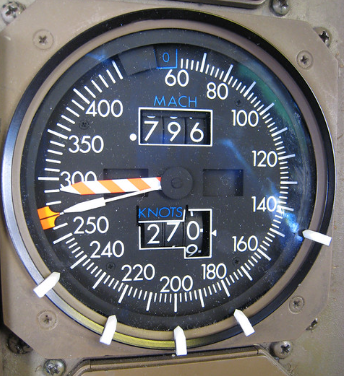
The white bugs can be moved around once V-speeds are calculated.
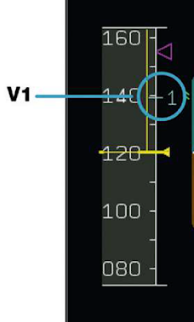
On Electronics PFDs, v-speeds will be displayed on the airspeed strip once they are entered into the flight computer.