


A traffic circuit, also known as a traffic pattern, is a standardized path flown by aircraft around an aerodrome during takeoff and landing operations. It allows pilots and air traffic controllers to maintain an orderly flow of traffic while ensuring adequate separation between aircraft.
Why Traffic Circuits Matter ?
Traffic circuits provide a predictable environment where pilots can:
- Practice takeoffs and landings
- Maintain situational awareness
- Integrate safely with other traffic
- Operate efficiently at both controlled and uncontrolled airports
The Standard Circuit
A standard traffic circuit consists of five legs:
1. Upwind Leg
The aircraft continues straight ahead after takeoff, aligned with the runway centerline.
2. Crosswind Leg
A 90-degree turn from the upwind leg, allowing the aircraft to move away from the runway.
3. Downwind Leg
The aircraft flies parallel to the runway in the opposite direction of landing. This is where pilots often conduct pre-landing checks.
4. Base Leg
A 90-degree turn from downwind toward the runway, positioning the aircraft for final approach.
5. Final Approach
The aircraft aligns with the runway centerline and descends for landing.
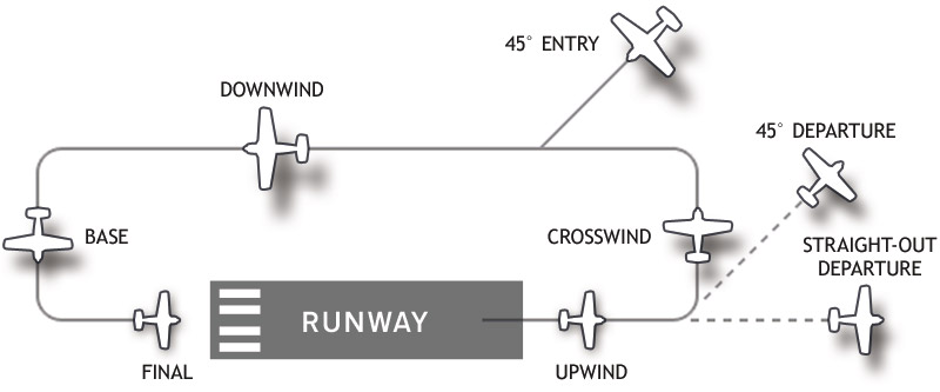
Left-Hand and Right-Hand Circuits
Most aerodromes use left-hand circuits meaning all turns are made to the left. Pilots should assume a left-hand circuit unless ATC instructs otherwise (controlled aerodromes) or, the chart specifically publishes a right-hand circuit (uncontrolled aerodromes). However, some airports publish right-hand circuits due to terrain, noise abatement procedures, or local airspace restrictions.Pilots should always consult airport charts and ATC instructions before joining a circuit.
Variations in Circuit Design
While the classic rectangular circuit is the most widely recognised pattern, not all aerodromes use the same layout. Some airports, particularly uncontrolled aerodromes, publish circuit patterns that differ from the standard shape due to:
- Terrain or obstacle considerations
- Noise abatement procedures
- Nearby airspace restrictions
- Deconfliction with neighboring aerodromes
Circuit Altitude
Circuits are normally flown at 1000 ft AAL (Above Aerodrome Level) unless otherwise specified.
Joining the Circuit at Uncontrolled Aerodromes
- At uncontrolled aerodromes, aircraft joining the circuit typically do so via an overhead join, although local procedures may vary.
- An overhead join is usually flown at circuit altitude when the runway in use is known. If the runway direction is not known, pilots may join overhead at approximately 500 feet above circuit altitude to allow safe observation of the aerodrome and existing traffic before descending to join the pattern.
- Other joining methods may be published for specific aerodromes and should always be followed where applicable.
- As a general principle, aircraft joining the circuit should avoid disrupting traffic already established within the pattern and should normally give way to aircraft already flying the circuit.
Circuit Operations at Controlled Aerodromes
Even where a published circuit exists, pilots operating at controlled aerodromes should expect ATC to provide instructions that may differ from the standard pattern in order to maintain traffic flow and separation.
Examples include:
- Extending or shortening circuit legs
- Delaying turns onto crosswind, base, or final
- Flying at a different circuit altitude
- Orbiting for traffic separation
- Joining the circuit at specific points
Pilots should comply with ATC instructions while maintaining safe aircraft operation and situational awareness.
Common Mistakes
Some common errors during circuit flying include:
- Turning too early or too late on circuit legs
- Flying inconsistent circuit altitudes
- Overshooting the final approach
- Poor speed management
- Failing to maintain visual separation
Conclusion
Traffic circuits form the backbone of aerodrome operations and are among the first procedures every pilot learns.